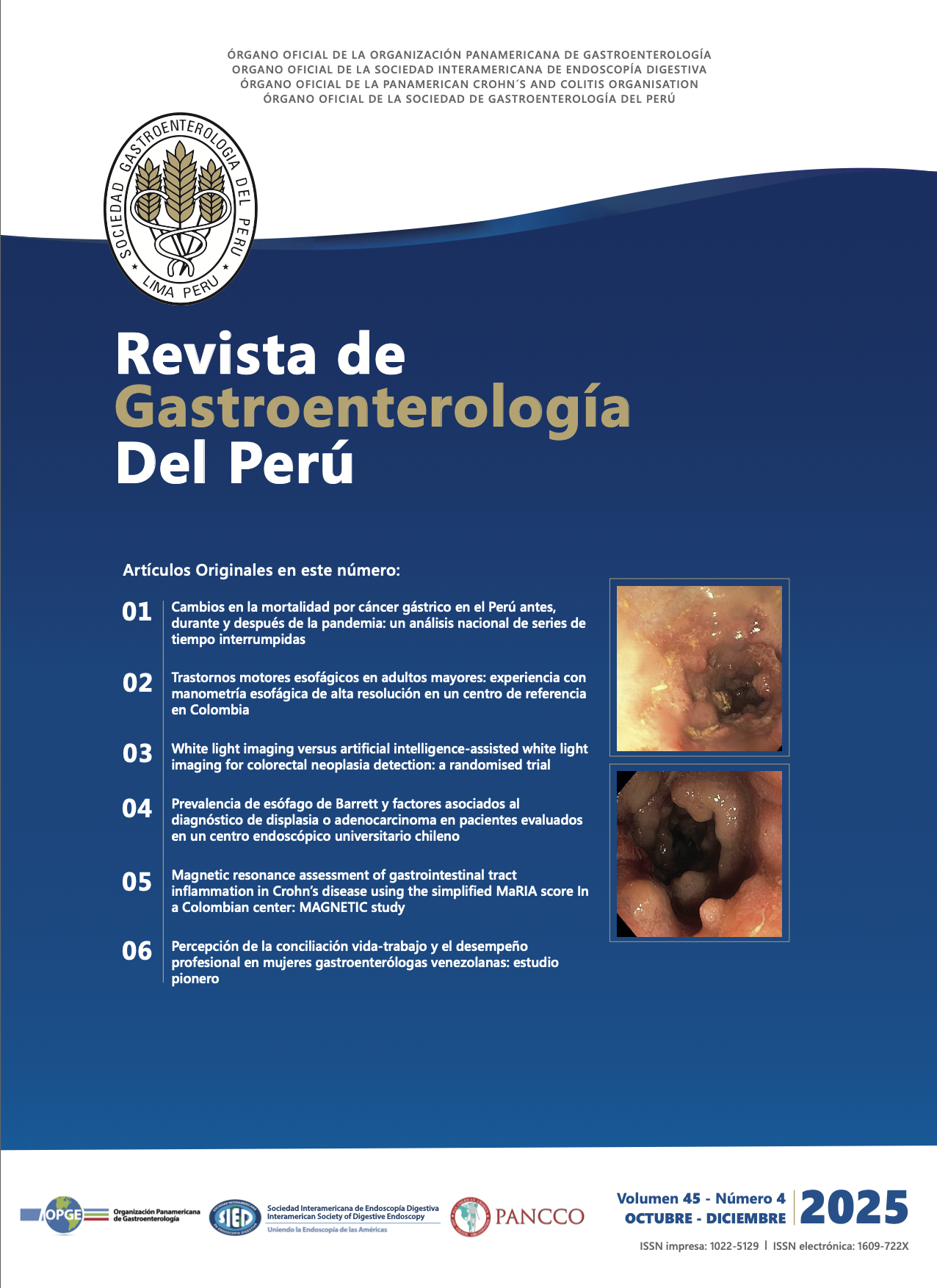
Perception of work–life balance and professional performance among Venezuelan female gastroenterologists: a pioneering study
DOI:
https://doi.org/10.47892/rgp.2025.454.2111Keywords:
Women, Work-Life Balance, Burnout, Job satisfaction, VenezuelaAbstract
Introduction: Worldwide, women represent a significant part, and even the majority, of medical personnel, evidencing a global trend towards the feminization of the profession. However, challenges persist in gender equality in leadership and academic roles. Understanding how women endoscopists manage the delicate balance between their demanding careers and personal lives is crucial to ensuring equitable professional environments. Objective: This research thoroughly explored these dynamics, seeking to understand the unique challenges, coping strategies and factors that influence the successful integration of personal and professional life for these specialists. Materials and methods: a survey was designed that addressed aspects of personal life, academic training, incorporating the Maslach Burnout Inventory (MBI) and the adapted MacDonald and MacIntyre job satisfaction scale. Results: The non-probabilistic sample included 202 female endoscopists aged between 29 and 73 years. It was found that those with children perceived difficulties in career advancement and a lack of workplace support during child-rearing. Nevertheless, there were no significant differences between women with and without children in the perception of workplace discrimination, professional advancement opportunities, or specialized training capabilities. A negative relationship was found between age and the perception of burnout. Job satisfaction, in turn, showed no correlation with any personal variables. Conclusion: These results suggest that, while motherhood imposes work-life balance challenges, professional experience may mitigate burnout, regardless of job satisfaction. Support and mentorship policies are required to achieve an inclusive environment.
Downloads
Metrics
References
López V, Olano C. Women in Gastroenterology in Latin America. J Clin Gastroenterol. 2022;56(10):819-820. doi: 10.1097/MCG.0000000000001761.
Feliu-Dominguez R, Medero-Rodriguez P, Cruz-Correa M. Women Gastroenterologists in Academic Medicine: Tradition Versus Transition. Dig Dis Sci. 2017;62(1):13-15. doi: 10.1007/ s10620-016-4369-x.
Gross R, McNeill R, Davis P, Lay-Yee R, Jatrana S, Crampton P. The association of gender concordance and primary care physicians’ perceptions of their patients. Women Health. 2008;48(2):123-44. doi: 10.1080/03630240802313464.
Pickett-Blakely O, Bleich SN, Cooper LA. Patient-physician gender concordance and weight-related counseling of obese patients. Am J Prev Med. 2011;40:616–619.
Schmittdiel JA, Traylor A, Uratsu CS, Mangione CM, Ferrara A, Subramanian U. The association of patient-physician gender concordance with cardiovascular disease risk factor control and treatment in diabetes. J Womens Health (Larchmt). 2009;18(12):2065-70. doi: 10.1089/jwh.2009.1406.
ASGE Membership and Diversity Committee; Day LW, Gonzalez S, Ladd AM, Bucobo JC, Pickett-Blakely O, et al. Diversity in gastroenterology in the United States: Where are we now? Where should we go? Gastrointest Endosc. 2016;83(4):679-83. doi: 10.1016/j.gie.2015.12.001.
Rao AH. From Professionals to Professional Mothers: How College-educated Married Mothers Experience Unemployment in the US. Work Employ Soc. 2019;34(2):299- 316. doi: 10.1177/0950017019887334.
Henderson LR, Dam R, Shah SGS, Ovseiko PV, Kiparoglou V. Perceptions of gender equity and markers of achievement in a National Institute for Health Research Biomedical Research Centre: a qualitative study. Health Res Policy Syst. 2022;20(1):102. doi: 10.1186/s12961-022-00904-4.
Wells K, Fleshman JW. Women in Leadership. Clin Colon Rectal Surg. 2020;33(4):238-242. doi: 10.1055/s-0040-1712977.
Hitti E, Moreno LA. The Gender Gap in Medical Leadership: Glass Ceiling, Domestic Tethers, or Both? [Internet]. Milwaukee, WI: American Academy of Emergency Medicine; 2017 [citado el 3 de enero de 20205]. Disponible en: https://www.aaemrsa. org/the-gender-gap-in-medical-leadership-glass-ceilingdomestic-tethers-or-both/
Aldakhil S, Baqar SM, Alosaimi B, Almuzirie R, Farooqui M, Alsahali S, et al. Perceived Needs, Barriers, and Challenges to Continuing Professional Development (CPD): A Qualitative Exploration among Hospital Pharmacists. Pharmacy (Basel). 2024;12(5):140. doi: 10.3390/pharmacy12050140.
Robbins SP, Judge TA. Organizational Behavior (18th ed.). Pearson Education; 2018.
Ng TWH, Feldman DC. The relationships of age with job attitudes: A meta-analysis. Pers Psychol. 2010;63(3):677-718. doi: 10.1111/j.1744-6570.2010.01184.x.
Deci EL, Ryan RM. (2000). The “what” and “why” of goal pursuits: Human needs and the self-determination of behavior. Psychol Inq. 2000;11(4):227-268. doi: 10.1207/S15327965PLI1104_01.
Kahn WA. Psychological conditions of personal engagement and disengagement at work. Acad Manag J. 1990;33(4):692- 724. doi: 10.5465/256287.
Embriaco N, Azoulay E, Barrau K, Kentish N, Pochard F, Loundou A, et al. High level of burnout in intensivists: prevalence and associated factors. Am J Respir Crit Care Med. 2007;175(7):686-92. doi: 10.1164/rccm.200608-1184OC.
Downloads
Published
How to Cite
Issue
Section
License
Copyright (c) 2025 Carla Dias, Suhey Pérez, Mercedes De Sousa, Yolette Martínez, Nina Colina, Maria Laura Salazar, Michelina Lafigliola, Lisbeth Mendoza, Yaritza Méndez, Yulidza Hurtado, Evelin Spitali, Solangel Rodriguez, Solangel Diaz, María Alejandra Chauran, Yaneth Flores, Antoinette Khoury

This work is licensed under a Creative Commons Attribution 4.0 International License.

Revista de Gastroenterología del Perú by Sociedad Peruana de Gastroenterología del Perú is licensed under a Licencia Creative Commons Atribución 4.0 Internacional..
Aquellos autores/as que tengan publicaciones con esta revista, aceptan los términos siguientes:
- Los autores/as conservarán sus derechos de autor y garantizarán a la revista el derecho de primera publicación de su obra, el cuál estará simultáneamente sujeto a la Licencia de reconocimiento de Creative Commons que permite a terceros compartir la obra siempre que se indique su autor y su primera publicación esta revista.
- Los autores/as podrán adoptar otros acuerdos de licencia no exclusiva de distribución de la versión de la obra publicada (p. ej.: depositarla en un archivo telemático institucional o publicarla en un volumen monográfico) siempre que se indique la publicación inicial en esta revista.
- Se permite y recomienda a los autores/as difundir su obra a través de Internet (p. ej.: en archivos telemáticos institucionales o en su página web) antes y durante el proceso de envío, lo cual puede producir intercambios interesantes y aumentar las citas de la obra publicada. (Véase El efecto del acceso abierto).




















 2022
2022