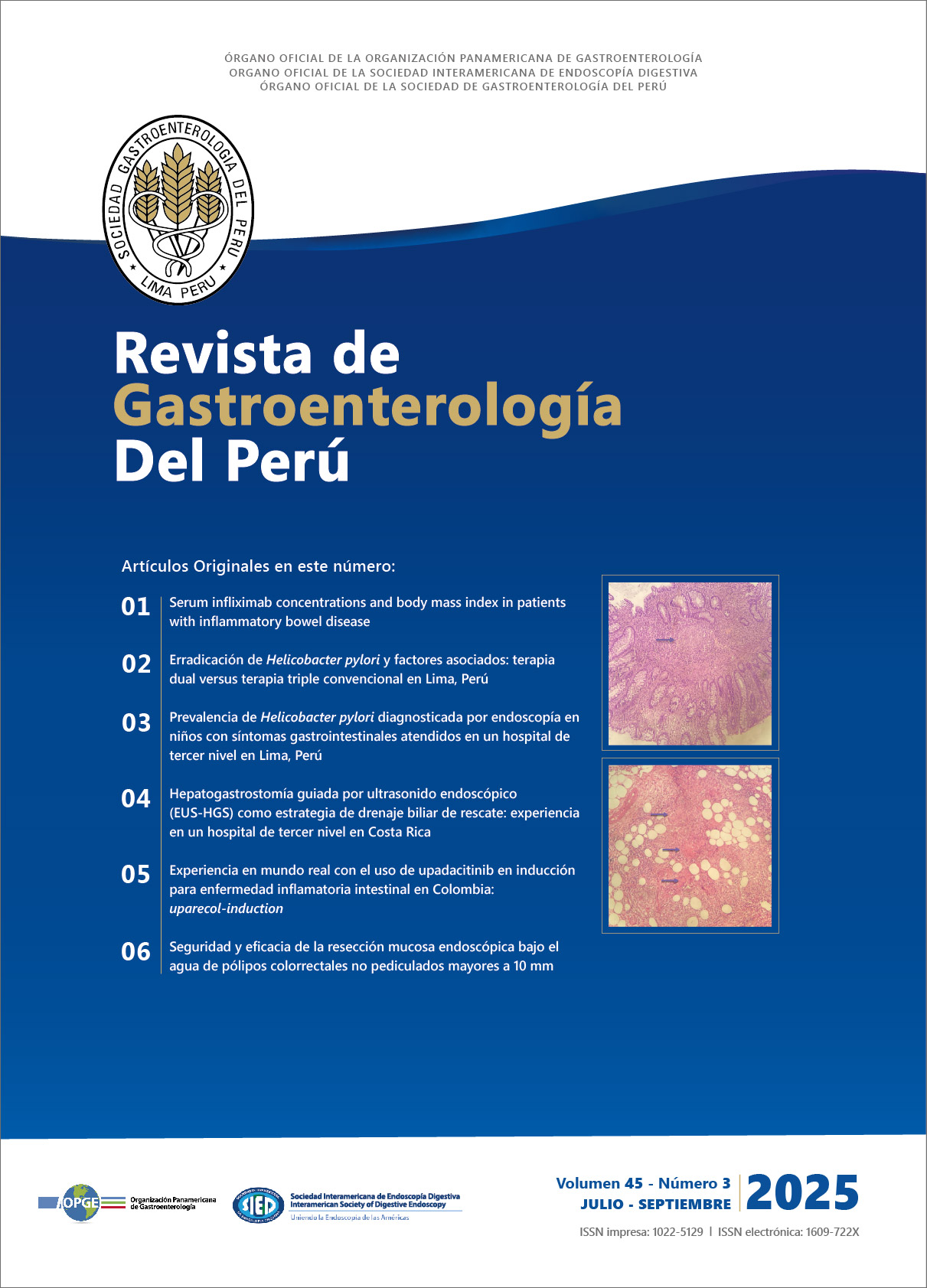
Serum infliximab concentrations and body mass index in patients with inflammatory bowel disease
DOI:
https://doi.org/10.47892/rgp.2025.453.2032Palabras clave:
Inflammatory Bowel Disease, Body Mass Index, InfliximabResumen
Background: Inflammatory bowel diseases (IBD), including Crohn’s disease (CD) and ulcerative colitis (UC), are chronic conditions associated with healthcare burdens. Advanced therapies, such as infliximab (IFX), have improved disease outcomes. However, the role of body mass index (BMI) in influencing IFX serum concentrations and treatment response remains unclear. Objective: This study aimed to evaluate the association between BMI and IFX serum concentrations during different disease activity phases. Materials and methods: This cross-sectional observational report categorized patients into eutrophic (BMI < 24.9 kg/m²) and overweight/obese (BMI ≥ 25 kg/m²) groups. Serum IFX concentrations were measured, and disease activity was assessed using clinical, laboratory, endoscopic, and/or radiologic criteria. Results: The analysis included 102 patients (80 with CD, 22 with UC). The median serum IFX concentration in eutrophic CD patients was 3.84 µg/mL (1.66–8.82), while in overweight/obese patients was 6.00 µg/mL (1.90–10.34), with no significant difference (p = 0.353). Among the 22 patients with UC, the median serum IFX concentration in eutrophic patients was 6.28 µg/mL (0.860–13.66), compared to 4.23 µg/mL (2.33–12.91) in overweight/ obese patients, with no significant difference (p = 0.920). No differences were found in IFX concentrations between patients in remission or active disease. Conclusions: this study did not confirm that BMI influences IFX concentrations. More studies are needed to explore the impact of BMI on IFX pharmacokinetics and therapeutic efficacy.
Descargas
Métricas
Citas
Lönnfors S, Vermeire S, Greco M, Hommes D, Bell C, Avedano L. IBD and health-related quality of life – discovering the true impact. J Crohns Colitis. 2014;8(10):1281-6. doi: 10.1016/j. crohns.2014.03.005.
Jean L, Audrey M, Beauchemin C, iGenoMed Consortium. Economic Evaluations of Treatments for Inflammatory Bowel Diseases: A Literature Review. Can J Gastroenterol Hepatol. 2018;2018:1-14. doi: 10.1155/2018/7439730.
Mao EJ, Hazlewood GS, Kaplan GG, Peyrin-Biroulet L, Ananthakrishnan AN. Systematic review with meta-analysis: comparative efficacy of immunosuppressants and biologics for reducing hospitalisation and surgery in Crohn’s disease and ulcerative colitis. Aliment Pharmacol Ther. 2017;45(1):3- 13. doi: 10.1111/apt.13847.
Spencer EA, Dubinsky MC. Therapeutic drug monitoring in inflammatory bowel disease: history and future directions. Pediatr Clin North Am. 2017;64(6):1309-26. doi: 10.1016/j. pcl.2017.08.008.
Guerbau L, Gerard R, Duyeau N, Staumont-Sallé D, Branche J, Maunoury V, et al. Patients with Crohn’s disease with high body mass index present more frequent and rapid loss of response to infliximab. Inflamm Bowel Dis. 2017;23(10):1853- 9. doi: 10.1097/MIB.0000000000001179.
Poon SS, Asher R, Jackson R, Kneebone A, Collins P, Probert C, et al. Body mass index and smoking affect thioguanine nucleotide levels in inflammatory bowel disease. J Crohns Colitis. 2015;9(8):640-6. doi: 10.1093/ecco-jcc/jjv084.
Harper JW, Sinanan MN, Zisman TL. Increased body mass index is associated with earlier time to loss of response to infliximab in patients with inflammatory bowel disease. Inflamm Bowel Dis. 2013;19(10):2118-24. doi: 10.1097/ MIB.0b013e31829cf401.
Puig L. Obesity and psoriasis: Body weight and body mass index influence the response to biological treatment. J Eur Acad Dermatol Venereol. 2011;25(9):1007-11. doi: 10.1111/j.1468- 3083.2011.04065.x.
Klaasen R, Wijbrandts CA, Gerlag DM, Tak PP. Body mass index and clinical response to infliximab in rheumatoid arthritis. Arthritis Rheum. 2011;63(2):359-64. doi: 10.1002/art.30136.
Singh S, Facciorusso A, Singh AG, Casteele NV, Zarrinpar A, Prokop LJ, et al. Obesity and response to anti-tumor necrosis factor-α agents in patients with select immune-mediated inflammatory diseases: a systematic review and meta-analysis. PLoS One. 2018;13(5). doi: 10.1371/journal.pone.0195123.
Tang W, Xie G, Li J, Tan W, Yi R, Yang L, et al. Body composition parameters correlate with the endoscopic severity in Crohn›s disease patients treated withinfliximab. Front Nutr. 2023;10:1251448. doi: 10.3389/fnut.2023.1251448. eCollection 2023.
Sturm A, Maaser C, Calabrese E, Annese V, Fiorino G, Kucharzik T, et al. ECCO-ESGAR Guideline for diagnostic assessment in IBD Part 2: IBD scores and general principles and technical aspects. J Crohns Colitis. 2019;13(3):273-84. doi: 10.1093/ecco-jcc/jjy114.
Maaser C, Sturm A, Vavricka SR, Kucharzik T, Fiorino G, Annese V, et al. ECCO-ESGAR Guideline for diagnostic assessment in IBD Part 1: initial diagnosis, monitoring of known IBD, detection of complications. J Crohns Colitis. 2019;13(2):144- 64. doi: 10.1093/ecco-jcc/jjy113.
Freeman K, Connock M, Auguste P, Taylor-Phillips S, Mistry H, Shyangdan D, et al. Clinical effectiveness and cost-effectiveness of use of therapeutic monitoring of tumour necrosis factor alpha (TNF-α) inhibitors versus standard care in patients with Crohn’s disease: systematic reviews and economic modelling. Health Technol Assess. 2016;20(83):1-288. doi: 10.3310/ hta20830.
Baumgart DC, Sandborn WJ. Inflammatory bowel disease: clinical aspects and established and evolving therapies. Lancet. 2007;369(9573):1641-57. doi: 10.1016/S0140- 6736(07)60751-X.
Singh S, Dulai PS, Zarrinpar A, Ramamoorthy S, Sandborn WJ. Obesity in IBD: epidemiology, pathogenesis, disease course and treatment outcomes. Nat Rev Gastroenterol Hepatol. 2017;14(2):110-21. doi: 10.1038/nrgastro.2016.181.
Bortolin Fonseca C, Petry R, Harlacher L, Hanauer L, Magalhães Francesconi CF, Gustavo Kotze P, et al. Body mass index does not influence loss of response to tumor necrosis factor inhibitors in Crohn’s disease. Gastroenterol Hepatol. 2025 Feb 4:502372. doi: 10.1016/j.gastrohep.2025.502372. Online ahead of print.
Bremer RN, Miranda EF, Marçal GN, Baraúna FSB, Loures MR, Senger PC, et al. Infliximab serum concentrations in luminal Crohn’s disease and its relationship with disease activity: a multicentric cross-sectional study. Gastroenterol Hepatol. 2023. doi: 10.1016/j.gastrohep.2023.12.011.
Teixeira FV, Sassaki LY, Saad-Hossne R, Baima JP, Magro DO, Coy CSR, et al. Serum infliximab measurement in inflammatory bowel disease patients in remission: a comparative analysis of two different methods in a multicentric Brazilian cohort. Arq Gastroenterol. 2018;55(2):192-7. doi: 10.1590/S0004- 2803.201800000-35.
Ricci RL, Gomes LEM, Pascoal LB, Silva FR, Ayrizono MLS, Fagundes JJ, et al. Avaliação dos níveis plasmáticos de Infliximabe por imunoensaio de fluxo lateral em pacientes com doença de Crohn. Rev Trab Iniciação Científica UNICAMP. 2019;27. Available from: https://www.prp.unicamp.br/ inscricao-congresso/resumos/2019P15180A3259202780.pdf.
Rowan CR, McManus J, Boland K, O’Toole A. Visceral Adiposity and Inflammatory Bowel Disease. Int J Colorectal Dis. 2021;36(11):2305-19. doi: 10.1007/s00384-021-03968-w.
Fang Y, Fang L, Ye M, Jiang H, Long X, Zhang H, et al. Low muscle mass is associated with efficacy of biologics in Crohn’s disease. Clin Nutr. 2024 Oct;43(10):2354-2363. doi: 10.1016/j. clnu.2024.09.003.
Descargas
Publicado
Cómo citar
Número
Sección
Licencia
Derechos de autor 2025 Gustavo de Nardi Marçal, Rodrigo Bremer Nones, Eron Fábio Miranda, Fernanda da Silva Barbosa Baraúna, Daniela Oliveira Magro, Paulo Gustavo Kotze

Esta obra está bajo una licencia internacional Creative Commons Atribución 4.0.

Revista de Gastroenterología del Perú by Sociedad Peruana de Gastroenterología del Perú is licensed under a Licencia Creative Commons Atribución 4.0 Internacional..
Aquellos autores/as que tengan publicaciones con esta revista, aceptan los términos siguientes:
- Los autores/as conservarán sus derechos de autor y garantizarán a la revista el derecho de primera publicación de su obra, el cuál estará simultáneamente sujeto a la Licencia de reconocimiento de Creative Commons que permite a terceros compartir la obra siempre que se indique su autor y su primera publicación esta revista.
- Los autores/as podrán adoptar otros acuerdos de licencia no exclusiva de distribución de la versión de la obra publicada (p. ej.: depositarla en un archivo telemático institucional o publicarla en un volumen monográfico) siempre que se indique la publicación inicial en esta revista.
- Se permite y recomienda a los autores/as difundir su obra a través de Internet (p. ej.: en archivos telemáticos institucionales o en su página web) antes y durante el proceso de envío, lo cual puede producir intercambios interesantes y aumentar las citas de la obra publicada. (Véase El efecto del acceso abierto).




















 2022
2022